Last week, I bought a Freewrite digital typewriter as a means for getting back in touch with my own writing voice. I'd recently come across an article in Futurism about a professor at Cornell who setup typewriters for her students to write in class as a response to AI. I was inspired by that to finally respond to a social media ad for a typewriter of my own.
Unlike the old school versions that the Cornell students are using, mine connects to Wi-Fi and sends everything I type to the cloud, but it will not let me search the web or ask a generative AI tool to finish my sentence. It is a very modern machine designed to give me space to be alone with my words for a while. It's my new goto place to write without autocomplete, formatting menus, spell check, or the quiet suspicion that every sentence had been laundered through AI before anyone read it.
This separation has been an instant game-changer, but I should be clear about something: I still use AI.
I use it often and openly. I do not see much virtue in pretending otherwise. It is one of the best writing tools if leveraged responsibly. I would not want to write without it, but sometimes I have no choice but to avoid it when a publisher forbids it. I disagree with that stance, but I faithfully honor their wishes. Regardless of where I start, the first drafts are my own.
This typewriter gives me one useful thing AI cannot give me: a first encounter with my own mess. No suggestions appear in the margin. No polite assistant offers to clarify my thought. No blue underline tries to save me from myself. The machine records what I actually typed, including the misspellings, repetitions, false starts, cheap shots, and sentences that felt brilliant for about twelve seconds.
That is why the phrase “AI slop” interests me.
I understand why people use it. There is a lot of bad AI-generated writing online. It is vague, polished, overconfident, and strangely empty. Nobody should want more of it.
Here is the counterpunch: humans produce slop too. Human slop may arrive with better intentions, more fingerprints, and a warmer origin story, but it still has to earn its place on the page.
I know because I do it every time I sit down to draft.
On my typewriter, what comes out may be authentic, but authenticity does not automatically make it good. A first draft can be human, sincere, original, and still be a mess. My words can wander. My words can repeat itself. I can misspell “distraction.” I can mistake intensity for clarity. I can contain three good sentences buried under twelve paragraphs of throat-clearing.
The tempting move is to forgive the human mess because a person made it and condemn the machine mess because a machine made it. I understand that instinct. A human draft carries accountability. Someone lived, noticed, misunderstood, wanted, feared, and chose. A machine has no life behind the sentence. It can produce language about grief without grieving, hunger without appetite, and memory without having lost anything.
That difference matters.
Still, the presence of a human origin story does not finish the work. The writer has to do something with the mess.
Here is a small example from this very essay.
My raw draft said: “AI alone is slop. Humans alone are slop. We have in our generation a brainstormer, an editor, an analyst, a researcher, and more.”
There was heat in that, but also noise. The first two sentences were punchy in a way that sounded more like a chant than an argument. The third sentence had a useful idea hiding inside it: AI can serve different roles in a writing process. So the composting work began. I cut the slogan, kept the pressure underneath it, and asked what I actually meant.
The revised thought became this: a first draft, whether typed by a person or generated by a machine, remains raw material until someone accepts responsibility for shaping it.
That sentence is less flashy than the original. It is also more honest. It can carry weight without shouting.
This is the practice I want to name.
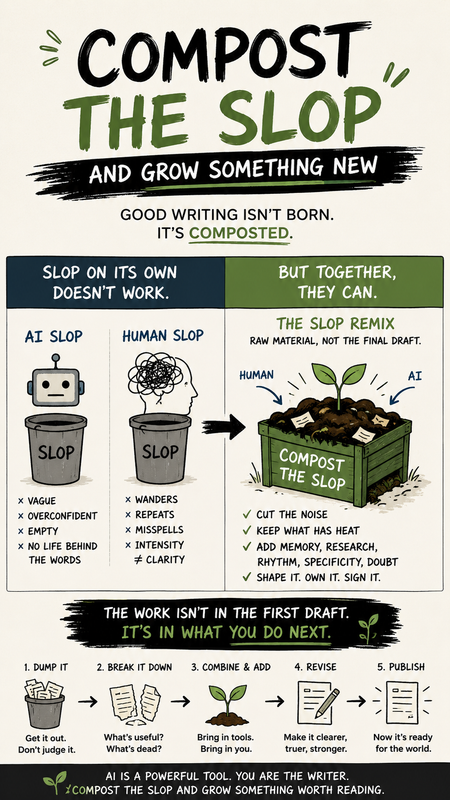
We need to compost the slop.
Composting is the discipline of refusing the first draft, whether it came from a person, a machine, or both. It asks the writer to treat raw language as material rather than verdict.
You refuse the first output. You refuse the easy phrasing. You refuse the paragraph that sounds finished only because it has no visible mistakes. Then you break the material down. You separate what is useful from what is dead. You ask what still has heat. You add memory, research, rhythm, specificity, doubt, humor, and consequence. You let the raw mess feed something better.
Sometimes I start with my own human slop. I write badly on purpose because I need something on the page. Then I bring in AI as a reader, pressure tester, editor, researcher, or counterargument machine. It catches things I missed. It offers connections I had not considered. It also gives me bland, false, or unusable material with perfect confidence.
That does not bother me. I do not need the tool to be perfect. I need to know what the tool is for.
I treat AI as software that can generate useful language and useless language with the same confidence. It can help me shape a paragraph, test an argument, or notice a weak transition. It can also hallucinate, flatten my voice, and hand me a sentence so smooth that it slides right past meaning.
The writer is the filter, the witness, and the one who signs the work.
That responsibility matters most when the work leaves the private draft and enters the world. A fabricated citation in a novel’s author’s note, a fake historical detail in an essay, a borrowed style passed off as personal voice, a flood of low-effort books uploaded to crowd out careful work: these are not abstract fears. They are failures of responsibility. They happen when a person uses a tool and then refuses to answer for the result.
I reject the idea that using AI automatically taints a piece of writing. I also reject the idea that AI use is harmless simply because the writer had good intentions. The standard should be more demanding than either purity or permission.
A writer should be able to explain how the tool entered the process, what changed because of it, what they checked, what they refused, and why the final piece still belongs to them.
Careful writers need standards, language, and practices for using AI well. That will not happen through panic, secrecy, or blanket shame. It will happen when we become more exact about the work.
Use AI when the draft needs pressure from another angle. Ask it to challenge a weak argument, then answer with evidence. Ask it where the piece sounds generic, then decide whether the criticism is right. Ask it to find holes, then choose which holes matter. Ask it for ten possibilities and expect nine of them to be unusable. Read the work aloud afterward until the borrowed rhythm falls away.
Then put the tool back in the toolbox.
That is the compost rule:
Do not post the slop. Compost it.
Cut the generic. Keep the heat. Add the human.
The typewriter helps me begin that process because it gives me my own unassisted draft before the tools arrive. It reminds me that my unaided sentences are not automatically noble. They are simply mine. That is enough for a beginning, but not enough for publication.
The AI tool helps later because it gives me friction, surprise, and another surface to push against. It reminds me that language can sound finished before it has earned meaning. That is useful too, as long as I remain the person making decisions.
Tonight, I began on a typewriter because I wanted to hear myself think without interruption.
Now I am powering it down.
The next step is to pick up the AI tool, pour this rough human draft into the compost bin, and see what can grow.
Note: AI Writers Retreat and the author have no affiliation with Freewrite and are not endorsing it.