.png&w=3840&q=75)
.png&w=3840&q=75)
AI Writers' Retreat · 8-Week Course
The City as Character
A self-paced writing course on making place do more than decorate the page.
This course is for writers who want place to do more than decorate the page. Across eight lessons, you'll study cities as living systems: streets, transit, money, weather, noise, memory, architecture, access, and desire. The course keeps returning to one practical craft question: what does this place make the character do?
- Format
- Self-paced
- Length
- 8 weeks + 2 supplemental lessons
- Focus
- Place, pressure, route, memory, sound, obstruction, endings
- Level
- Intermediate
- Output
- Urban scenes where the city cannot be removed without damaging the story
Course promise
By the end of the course, writers should be able to draft an urban scene where the city cannot be removed without damaging the story. The course moves away from postcard setting and toward scenes where location creates action, hesitation, exposure, cost, memory, and choice.
Introduction
Welcome to your AI Writers' Retreat course: The City as Character.
This course is for writers who want "place" to do more than decorate the page. We're going to study cities as living systems: streets, transit, money, weather, noise, memory, architecture, access, and desire. The aim is to help you write places that change what your characters can and can't do.
As your instructor, I'm based in San Francisco. I've lived with the strange intimacy of that city's hills, fog, tech wealth, old neighborhoods, sudden views, and disappearing histories. I'll draw from lived experience in San Francisco, from travel, from research, and from the books we study together. When we enter cities I know less intimately, we will do so with humility and care. The goal is to ask what pressure a place puts on a character, ensuring the scene is earned through attention, and never pretending we own the setting.
Place behaves differently depending on scale. A city compresses pressure. A small town concentrates attention. A highway tests endurance. A foreign train station can make a capable adult feel suddenly young. The backcountry can make the body understand distance before the mind has time to romanticize it. Therefore, we need to resist the impulse to write about the places we know in favor of placing our characters in the place that will add to our story.
In this course, we will keep returning to one question: What does this place make the character do? That question will guide each lesson. It will keep us away from decorative settings and move us toward scenes where location creates action, hesitation, exposure, cost, memory, and choice.
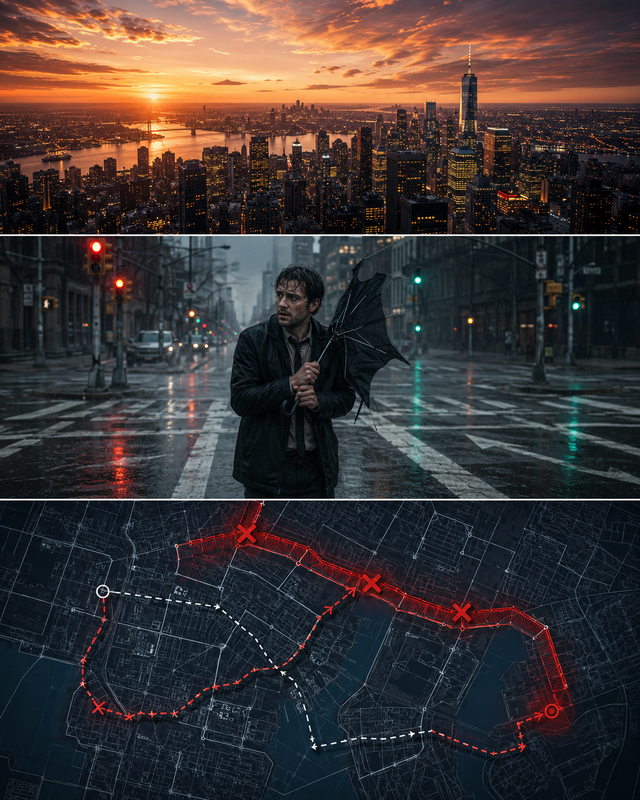
By the end of the course, you should be able to write an urban scene where the city cannot be removed without damaging the story. If the place can be removed without impacting the story, we have more work to do as a writer.
A note on the readings: I'm assigning one reading per lesson, and several of those readings are full books. Read them at your own pace as this is a do-it-yourself course free of deadlines and grading. If a week takes longer, let it take longer. The lectures and assignments are designed to stand on their own, but the readings will deepen the work when you have time to stay with them. For longer books, I will give you a specific craft focus so you know what to watch for even if you return to the book over more than one week.
We hope you enjoy this specialized retreat. Let's begin…
Core lessons
Week 1
Place as Pressure
When Place Changes the Scene
Learn how terrain, weather, distance, and architecture touch a character's plan before the scene officially begins.
Week 2
Route as Drama
Streets, Routes, and Movement
Use streets, transit, waiting, wrong exits, and detours to reveal desire, money, dread, and control.
Week 3
Thresholds & Access
Neighborhood, Class, and Belonging
Write neighborhoods as places that read characters back through gates, parking, lobbies, cameras, and codes of entry.
Week 4
City as Archive
Memory in the Built Environment
Use surviving details—kick plates, tile, railings, doorways, and changed rooms—to let the city bring the past into the present.
Week 5
Night as Permission
Danger, Desire, and the Night City
Study how darkness changes what a character allows themselves to risk.
Week 6
Sound as Pressure
The City’s Voice
Use sound, silence, overheard voices, and ordinary noise to reveal a character’s position in the room.
Week 7
Obstruction & Plot Pressure
When the City Pushes Back
Turn floods, closures, delays, rules, and locked doors into believable pressure on a character's goal.
Week 8
Ending as Echo
Letting the City Haunt the Ending
Return to a route, object, sound, threshold, or obstruction so the city leaves a mark on the final scene.
Supplemental lessons
Supplemental Lesson
Research with Humility
On Writing Places You Have Never Been
Learn how to research unfamiliar places through routes, friction, local voices, practical conditions, and character pressure without faking authority.
Supplemental Lesson
AI Research Workflow
Using AI Tools to Research and Write Place
Use AI as a research assistant, map partner, source organizer, cliché detector, and skeptical reader while keeping authority with the writer.
Supplemental reading
A Comprehensive Reading List for Writers
A selective craft reading map for studying place across U.S. and international cities.
View reading list →