.png&w=3840&q=75)
.png&w=3840&q=75)
Week 1 of 8
Place as Pressure
When Place Changes the Scene
Learn how terrain, weather, distance, and architecture touch a character's plan before the scene officially begins.
Lecture
Recorded lecture
I learned one of my best lessons about writing cities on a hill in San Francisco.
It was not a famous hill. That matters. Nobody was taking photos of it. It was just one of those ordinary residential climbs where the sidewalk tilts enough to make you aware of your shoes, your lungs, your age, your mood, and whether you have been pretending you are in better shape than you are.
I was walking to meet someone. I remember thinking, at the bottom of the hill, that I would arrive composed. I had a version of myself ready for the conversation. Calm. Light. Slightly amused. The kind of person who had not hurried, had not overthought anything, had not invested too much meaning in the meeting.
Then the hill got involved.
By the time I reached the top, my shirt was sticking to my back. My breath had shortened. The sentence I had planned to open with had broken apart somewhere halfway up the block. I had to stand outside for a moment before ringing the bell, which ruined the whole fiction of casualness. The city had taken away the performance I meant to give.
That is the kind of thing I want you to notice as a writer.
This distinction is crucial, and it’s often easiest to spot by looking at the difference between a decorative setting and a consequential one.
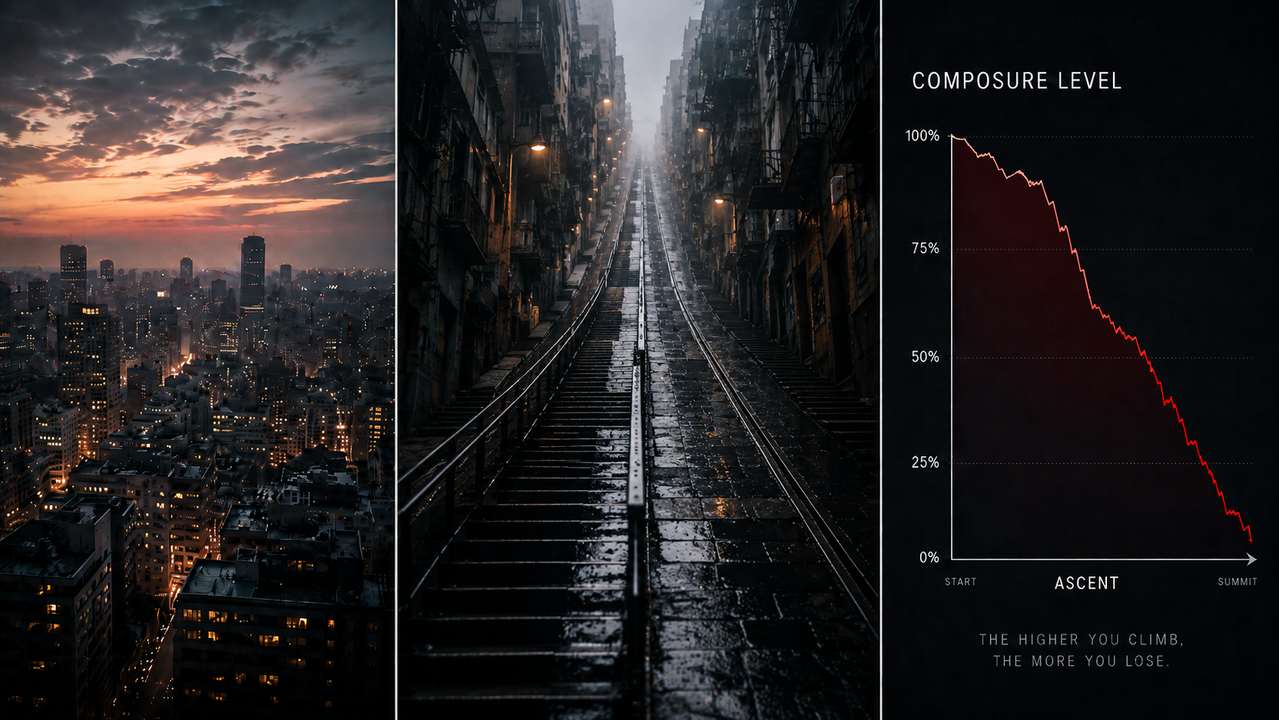
Let’s use this real life example as writing practice.
Evan walked through San Francisco to Mira’s apartment. The city was beautiful in the evening, with lights coming on in the windows and fog moving between the buildings. He thought about what he would say when he saw her.
There is nothing embarrassing about that paragraph. It has a character, a destination, a city, and an emotional situation. Many early drafts sound like this because the writer is trying to establish the atmosphere before the scene begins. The problem is that San Francisco has not changed anything yet.
The city is visible without exerting any authority. The lights are pretty. The fog is pretty. The apartment is waiting. Evan is thinking. The paragraph gives us a postcard with a worry attached to it.
Now let’s consider a version where San Francisco is useful:
Evan had planned to arrive as if the visit had cost him nothing. The hill ruined that. By the time he reached Mira’s block, his breath was uneven and the back of his shirt had gone damp beneath his jacket. He stopped beside a parked car and pretended to check his phone, waiting for his body to become believable again.
This version focuses on giving the city power, thereby minimizing its role as mere decoration.
The hill creates a physical problem. The physical problem creates an emotional problem. Evan wants to seem casual, but his body is now telling a different story. The climb has made his desire visible before he has said a word.
When you write a city, begin by asking what the place does to the character’s plan versus asking how to make the place sound beautiful.
In this example, Evan’s plan is simple. He wants to control how he appears. He wants to arrive with his dignity intact. The city interferes in a small, believable way. Nobody attacks him. Nothing dramatic happens. The train does not explode. The weather does not become symbolic. The city simply makes him climb.
That is enough because the climb puts pressure on the exact thing he is trying to hide.
This is where urban fiction becomes truly kinetic. The city becomes useful the moment it touches the character’s plan. In Evan’s case, the hill changes his body before Mira ever opens the door. He wanted to arrive casually. The climb makes that impossible.
Let’s stay with the example a little longer.
The weaker paragraph uses San Francisco as scenery:
The city was beautiful in the evening, with lights coming on in the windows and fog moving between the buildings.
If we remove that sentence, the paragraph loses decoration without the scene itself changing.
The stronger version makes the hill part of the action: The hill ruined that.
That sentence works because it connects place to intention. Evan has a social performance in mind. The hill damages the performance. The city has entered the scene.
The next sentence keeps the focus on consequence:
By the time he reached Mira’s block, his breath was uneven and the back of his shirt had gone damp beneath his jacket.
This is not just sensory detail. It is evidence. We can read the body. We understand, before Mira opens the door, that Evan is already losing control of the encounter.
Then he pretends to check his phone.
That small gesture matters. He is not checking his phone because the phone is important. He is buying time. He is trying to restore the version of himself he intended to present. The city has forced him to act.
That is what you are looking for in your own scenes. You need to make it consequential.
Evan wants to arrive casual, but the climb changes the scene before Mira opens the door. His breath is uneven. His shirt is damp. He has to stop beside a parked car and pretend to check his phone. That fake phone-check is the real craft move. It shows us a character trying to repair the image of himself that the city just damaged. The hill has created action, not atmosphere.
For this lesson, I want you to practice finding that touchpoint.
Start with a character’s simple desire. Perhaps your character wants to apologize to somebody. Now place that desire in a city. Ask what the city can do to apologize before the character reaches the room. Don’t worry about describing the skyline or the atmosphere yet. Maybe your character misses the train and has twenty minutes to lose courage. Maybe the restaurant is too expensive, and the apology curdles into resentment before the other person arrives. Maybe the apartment building has a doorman, and the character has to say the name out loud to a stranger.
Each version creates a different scene because each city condition changes the apology. That is the point of this first lesson. Place becomes active when it changes the terms of the character’s desire.
Stay with Evan for a moment longer.
He has reached the top of the hill. His shirt is damp. His breath has betrayed him. He pauses beside the parked car and pretends to check his phone because he needs a few seconds to become the person he meant to be when Mira opens the door.
That is where Lesson One leaves us: the city has touched the character’s plan.
But notice something else. The scene did not begin at Mira’s door. It began on the way there. That matters more than it may seem at first. Many writers hurry through movement because they are trying to get to the “real” scene: the apology, the argument, the kiss, the confrontation, the discovery. They summarize the character’s travel because travel feels like connective tissue.
- Evan walked to Mira’s apartment.
- Lena took the bus to the hospital.
- Jonah drove across town.
- Mei got off at the wrong station.
Those sentences move people around, but they do not yet make the movement meaningful.
The route is often where the character starts to reveal themselves. A person can change their mind on the way to a door. They can lose courage on a train platform. They can choose the long way and pretend it was an accident. They can spend money to avoid being seen. They can save money and pay for that decision with discomfort.
.png)
So, in lesson two, we’ll move from the city as pressure to the route as drama.
We are going to look at streets, transit, walking, waiting, and the small decisions characters make before they arrive. While the destination is important, the route offers greater insight, revealing how badly the character wants to get there, what they are willing to endure, and what they are quietly hoping will stop them.
Reading
Before you read Here Is New York, I want you to forget the idea that a city essay has to behave like a tour. White gives you New York as temperament. He writes the city as pressure, appetite, contradiction, daily adjustment, and private weather. That is exactly why we begin here.
White famously divides New Yorkers into three types: those who were born there, those who commute there, and those who were born elsewhere and came in quest of something. It is this third group—the settlers—that he finds most significant. For them, New York is not just a place to live or work, but a final destination, a goal that validates their ambition or escape.
.png)
Read the whole book slowly. It is short, and that can make it easy to underestimate. Let yourself notice how often White moves from a public observation into a human one. He may begin with buildings, crowds, arrivals, or habits, but the real subject is always the city's "peculiar quality of being aloof yet dense." He explores how the city provides a "gift of privacy" and "the excitement of participation."
As you read, keep one question beside you: what kind of person does this city make possible?
White understands New York as a place of constant transaction and exchange. A person can become anonymous there, ambitious there, lonely there, sharpened there, swallowed there, or strangely protected there. He is writing about an environment that fundamentally changes the terms of a life, proving the setting is far from neutral.
After you finish, choose one paragraph where White seems to be describing the city. Read it again and look for the human behavior underneath. Who is adjusting? Who is enduring? Who is being changed by the arrangement of the place? You may begin with the city, but you must follow the details until they directly touch a person.
Writing Activity
The Place Touches the Plan
Take a character who has rehearsed how they want to appear. They may want to seem calm, wealthy, indifferent, brave, sober, generous, unbothered, professional, or over someone they still love.
Now put them in a city that interferes with that performance before the meeting begins.
Use one physical feature of the city. A hill. A station exit. A long lobby. A bridge. A walk from the parking lot. A door with a camera. A weather change at the wrong moment.
Write the scene up to the instant before the character speaks.
We want to see the city alter the body first. Breath, sweat, posture, timing, hands, clothes, balance, eye contact. Let the place make the character less prepared than they planned to be.
End with the character at the threshold.
The best version of this scene will make us understand the character’s desire before they explain it.